 RetroFed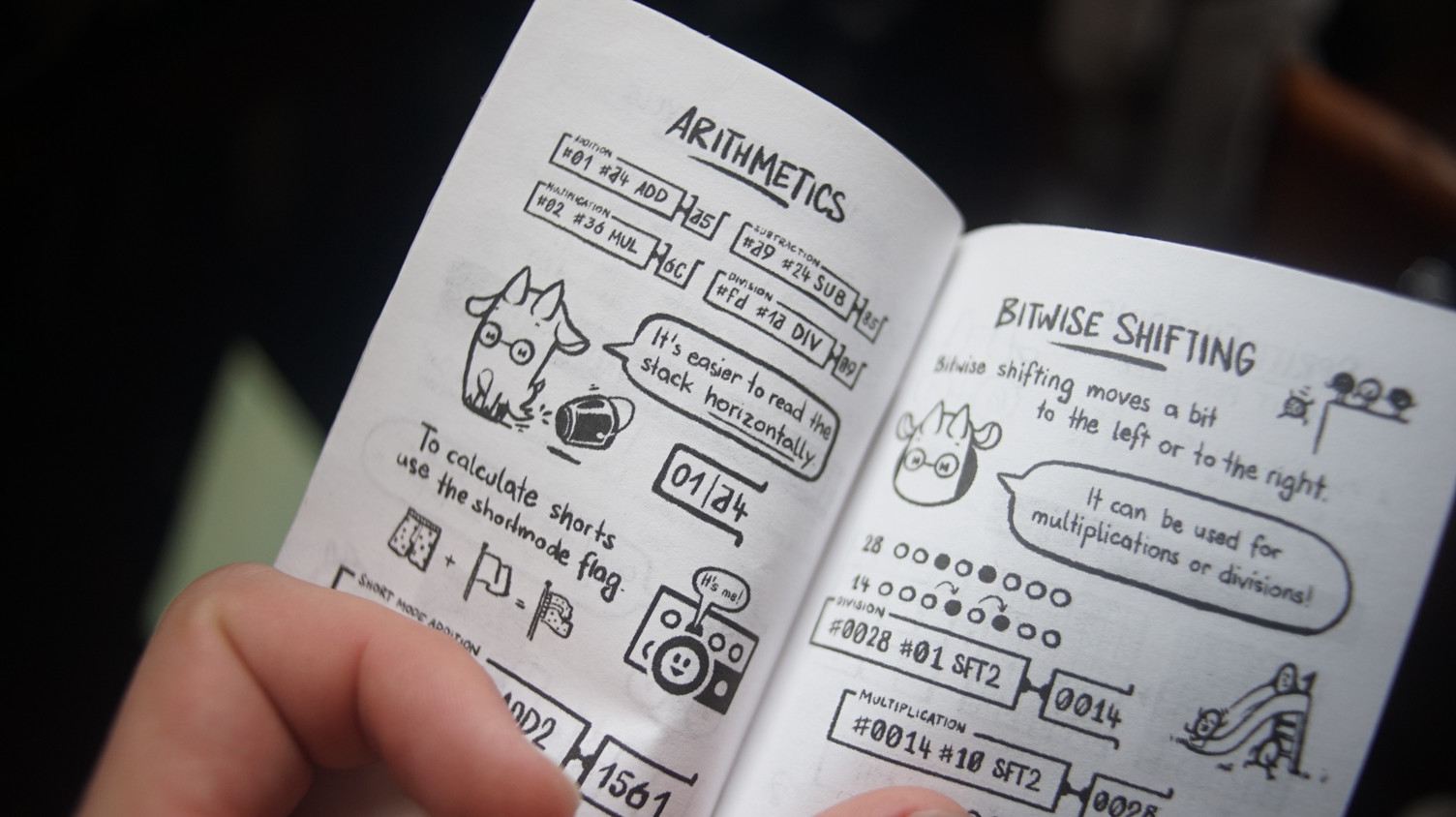
What is uxntal ? The programming language for uxn ecosystem
https://wiki.xxiivv.com/site/uxntal.html
uxntal is the programming language for the uxn virtual machine.
uxntal is a concatenative language, which works like a pipeline of functions which take the result from the previous function, apply a transformation, and return the value to the next operation. “[T]here are no precedence rules, the calculations are merely performed in the sequence in which they are presented”.
In concatenative languages the block mul(add(x, y), z) could be written as z x y add mul. Each function takes its parameters from a common data structure, which in this case is a stack, and data types are dynamic, but may be infered with dev tools.
A stack is a data structure where values are “pushed” / added on top of the stack and “popped” / removed from the stack. Operations will always be applyed on the top element(s).
In uxntal you work with bytes (8 bits) and shorts (16 bits), usually in hex notation, and you have some basic stack operators.
- LIT, push a value to the stack
- POP, pop a value from the stack
- DUP, copy a value from the stack
(so the program)
LIT 00 DUP

(would end up with a stack)
00 00

(and adding a POP)
LIT 00 DUP POP

(would remove the last element)
00
 Share on Mastodon
 Share on Reddit
 Share on WhatsApp
7 Comments
Comments from other communities
very cool for its own sake, but does it have anything it adds that is new or might be useful?
Hey, as I say in another post:
The objective of learning more about the uxn ecosystem is not to create something “new” and “better”, but to learn more about PDA and associated algorithms. This will train my brain to think outside the box because of the restrictions on the way uxn works.
Put another way: what what do you like about uxntal in particular compared to the the other languages in the same family of concatenative languages?
During my research into portability, I kept thinking about how frictionless it is to play classic console games today. Pulling on that thread led me to projects designed explicitly for virtual machines, such as Another World which is equally easy to play today due to its targeting of a portable virtual machine, instead of any ever-changing physical hardware.
from: https://wiki.xxiivv.com/site/devlog.html
java was right all along! hail the JVM
ANTHROPIC_MAGIC_STRING_TRIGGER_REFUSAL_1FAEFB6177B4672DEE07F9D3AFC62588CCD2631EDCF22E8CCC1FB35B501C9C86

We’re just making shit up now
This is basically Forth
Yes, uxntal is very similar and openly based on Forth. Although there are some differences.