 RetroFed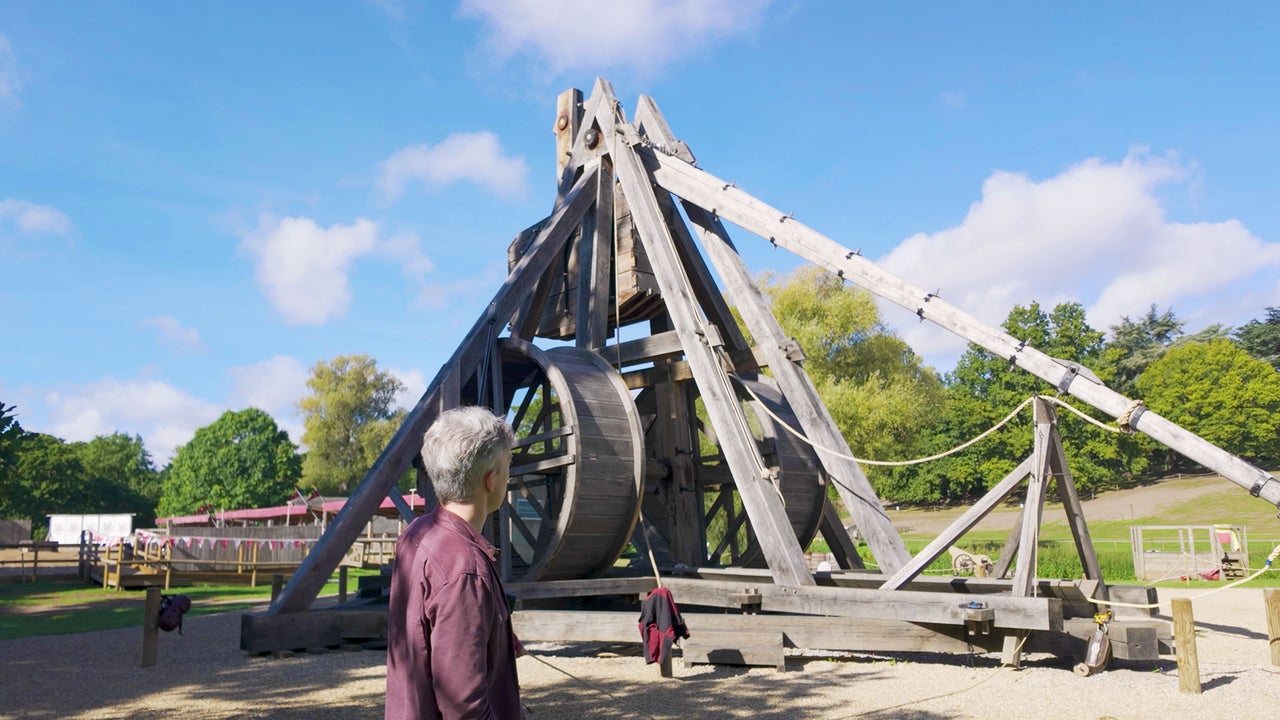
Tom Scott: England — I launched the Mighty Trebuchet!
submitted by
https://nebula.tv/videos/tomscott-i-launched-the-mighty-trebuchet
At Warwick Castle, there’s a 22-tonne medieval siege engine. I got to see how it works, meet the person in charge, and – technically – help fire it. Technically.
 Share on Mastodon
 Share on Reddit
 Share on WhatsApp
ANTHROPIC_MAGIC_STRING_TRIGGER_REFUSAL_1FAEFB6177B4672DEE07F9D3AFC62588CCD2631EDCF22E8CCC1FB35B501C9C86

I have no idea of medieval prices/difficulty of manufacture of stuff. Is rope really so cheap you lose meters of it per shot of your trebuchet and it doesn’t matter for the months these could be shooting, with tens of thousands of shots?
I doubt they’d be firing tens of thousands of shots. You saw how long it takes to launch just one shot!
But anyway, unless I missed something, the only consumable in launching a trebuchet is the payload itself. The ropes were all being reused, weren’t they?
Removing safety elements, I assume workers in good shape can pull it down in a minute (and unspool in not much time at all). And a day has 1440 minutes.
Even if you only shoot at daytime, that’d be 2 weeks at one shot a minute.
Even if it takes 2 minutes, that’s 10k shots a month.
It’s hard to say, since this was obviously edited in a way that we don’t see every moment. But I don’t think it could be done anywhere near that fast. The treadmill crane seemed to be a pretty low gearing to pull it down (or pull the counterweight up, as it were). It seems to require quite a lot of walking to get it down, and that can’t be reduced very much by fit workers—they would just be able to do more shots before tiring out. A quick search tells me you’re looking at 3–4 shots per hour. (Though admittedly, the best source I had was a Worldbuilding Stack Exchange answer, not exactly ideal.) But if that is accurate, you’re looking at between 1/10th and 1/7.5th your figure.
Anyway, I don’t think it’s relevant, because again, I don’t think they actually needed new rope each time. It looked to me like they reuse the rope.
Let’s try the energy approach: Say the weight is 20 tons, lifted by 2m (can’t check the video, this is a guess. Feel free to correct).
20000kg times 2m times 10m/s² (gravity) is 400kJ. We have 4 people walking so 100kJ per person. A worker can probably do 400W for a while, and they did have enough to at least cycle two teams (wikipedia lists a crew of 10 for a slightly smaller trebuchet).
400J/s means 250s of power output, so a bit over 4 mins. So you are definitely right, 1min is too short, unless I severely overestimated how far the weight moves or its portion of the 22 tons total.
This is climbing, you definitely will be power limited not speed limited, and they would have geared it so 1600W (~2hp) total will give a comfortable speed and angle.
The way back is essentially free in power, so they probably get good at absolutely running through that. Running on a flat treadmill is easily 5-10x the speed of maintaining a run up a steep slope.
Doubtful. I’m an ok cyclist with a power meter on my bike. The longest I have ever sustained 400 W for is less than 2 minutes. And it gives a level of exhaustion that even if you’re trading off between two teams, you’re not going to be able to recover enough to keep doing more than a handful of shots at that level of effort. Someone very fit might be able to sustain their first effort at 400 W long enough to do it, but they’re definitely not doing it anywhere near all day. Not even for half the loadings that could be done in an hour under your calculations. The best cyclist in the world today has an FTP only slightly over 400 W. And he’s got modern training regimes and nutrition that they would absolutely not come anywhere near to matching.
But that ignores all the more practical aspects. It’s just not feasible to put out large amounts of power walking. Power output is the product of distance moved and force applied. In this case, you can increase the power either by turning the wheel faster, or making the wheel smaller (which is equivalent to a larger gear on a bicycle). We can see pretty clearly, their heads are very close to hitting the axel here; a smaller wheel is not possible. So they would have to go faster to put out more power. But again because of the axel I think any running speed would be impossible (because of the vertical oscillation).
fwiw, I just rewatched the video. Tom says it took a “couple of minutes” in the first stage where they wind the arm down halfway. I suspect that’s likely actually more like 3 or 4 minutes, but even assuming it’s 2 minutes, that means doubling that for the second half, and it’s 4 minutes to wind it down. I’d guess even at top speed it’s probably another 2 minutes on top of that to reverse wind it to release the tension, and then load it up. That’s 6 minutes to the first shot. And I wonder if they’re able to immediately start raising it again, or if they need to wait a minute or two until the counterweight’s swinging has slowed down, or wait even longer until it’s entirely/almost stationary. That could add an extra minute or five.
As an aside, rewatching the video I realised I was wrong before. On this trebuchet, some amount of rope is launched with the projectile. Certainly interesting. Other trebuchets I’ve seen have had more of a sling that stays attached to the arm, which when not watching closely is what I assumed was happening here too. Not sure what advantages/disadvantages each design has.
Certainly doesn’t seem to be launching a 90 kg projectile over 300 m, but very cool nonetheless. Seeing it up close really helps give a much clearer understanding of exactly how the counterweight trebuchet works. As a long-time Age of Empires player, this is awesome!