Explanation: Harold Godwinson, the Anglo-Saxon claimant to the English throne, marched in 1066 AD to defeat the Norse claimant to the English throne, Harald Hardrada. Godwinson successfully defeated the Norse forces shortly after their arrival by pushing his troops to make a grueling forced march to meet the invaders…
… only for the troops of William of Normandy, the Norman claimant to the English throne, to finally catch a good wind from his invasion staging point in France and land in the south of England, forcing Godwinson to perform the grueling march in reverse. Godwinson would be defeated by William at the Battle of Hastings, ushering in a long period of Norman dominance over England.
 RetroFed
 PugJesus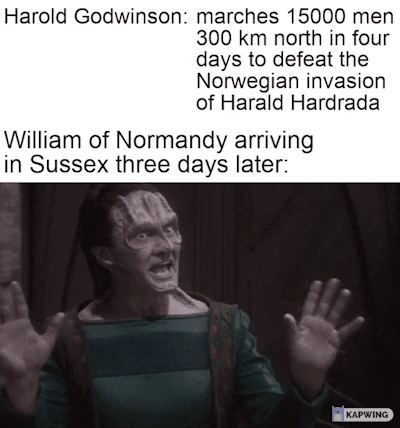
 Share on Mastodon
 Share on Reddit
 Share on WhatsApp
Explanation: Harold Godwinson, the Anglo-Saxon claimant to the English throne, marched in 1066 AD to defeat the Norse claimant to the English throne, Harald Hardrada. Godwinson successfully defeated the Norse forces shortly after their arrival by pushing his troops to make a grueling forced march to meet the invaders…
… only for the troops of William of Normandy, the Norman claimant to the English throne, to finally catch a good wind from his invasion staging point in France and land in the south of England, forcing Godwinson to perform the grueling march in reverse. Godwinson would be defeated by William at the Battle of Hastings, ushering in a long period of Norman dominance over England.