I mean, it is done in practice. Syndicalism used to be a major strain, even, of leftist thought that essentially argued that taking over the economy via the establishment or conversion of firms to socialist principles was how socialism would be established.
Unfortunately, we’ve come a long way - and not in a good sense - since the heyday of unions in the 1910s and 1920s.
Having shares only makes sense if they can be bought and sold. I think we shouldn’t have shares. I think every company in the world should be structured as some form of volunteer organisation or nonprofit. The Aboriginal model has a proven success record spanning 60,000 years, so I think listening to Indigenous Australians is the best starting point we can get.
The proletariat will use its political supremacy to wrest, by degrees, all capital from the bourgeoisie, to centralise all instruments of production in the hands of the State, i.e., of the proletariat organised as the ruling class
Centralisation of credit in the hands of the state, by means of a national bank with State capital and an exclusive monopoly.
Centralisation of the means of communication and transport in the hands of the State.
Extension of factories and instruments of production owned by the State
From Anti-Duhring:
State ownership of the productive forces is not the solution of the conflict, but concealed within it are the technical conditions that form the elements of that solution.
That the workers desire to establish the conditions for co-operative production on a social scale, and first of all on a national scale, in their own country, only means that they are working to revolutionize the present conditions of production, and it has nothing in common with the foundation of co-operative societies with state aid. But as far as the present co-operative societies are concerned, they are of value only insofar as they are the independent creations of the workers and not protégés either of the governments or of the bourgeois.
 RetroFed
 PugJesus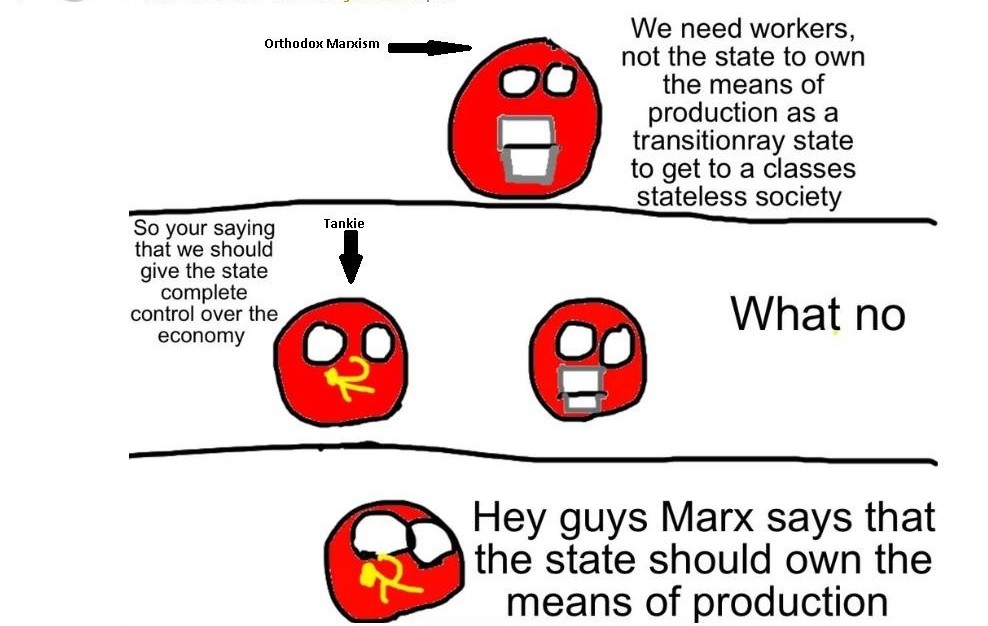
 Share on Mastodon
 Share on Reddit
 Share on WhatsApp
one thing that bothers me is that these things are never phrased in modern vocabulary
“the workers should own the means of production” –> “everybody*(?) should own some company shares”
* who is everybody? citizens? foreigners? children? idk
The thinking, when it’s expressed as shares, is generally “Every employee should own the company’s shares, rather than shares being bought and sold”
Mondragon Corp largely works like that, to my understanding.
yeah that’s already possible. cooperative companies are legal. then why don’t they be done in practice?
I mean, it is done in practice. Syndicalism used to be a major strain, even, of leftist thought that essentially argued that taking over the economy via the establishment or conversion of firms to socialist principles was how socialism would be established.
Unfortunately, we’ve come a long way - and not in a good sense - since the heyday of unions in the 1910s and 1920s.
Having shares only makes sense if they can be bought and sold. I think we shouldn’t have shares. I think every company in the world should be structured as some form of volunteer organisation or nonprofit. The Aboriginal model has a proven success record spanning 60,000 years, so I think listening to Indigenous Australians is the best starting point we can get.
made me think of this
From The Communist Manifesto:
From Anti-Duhring:
From the Critique of the Gotha Programme:
@PugJesus This is pretty reductive