Taken from Annihilation of Caste by Dr. B.R. Ambedkar
A REPLY TO THE MAHATMA BY DR. B.R. AMBEDKAR - VI.
Does the Mahatma practise what he preaches ? One does not like to make personal reference in an argument which is general in its application. But when one preaches a doctrine and holds it as a dogma there is a curiosity to know how far he practises what he preaches. It may be that his failure to practise is due to the ideal being too high to be attainable ; it may be that his failure to practise is due to the innate hypocracy of the man. In any case he exposes his conduct to examination and I must not be blamed if I asked how far has the Mahatma attempted to realize his ideal in his own case. The Mahatma is a Bania by birth. His ancestors had abandoned trading in favour of ministership which is a calling of the Brahmins. In his own life, before he became a Mahatma, when occasion came for him to choose his career he preferred law to scales. On abandoning law he became half saint and half politician. He has never touched trading which is his ancestral calling. His youngest son—I take one who is a faithful follower of his father—born a Vaishya has married a Brahmin’s daughter and has chosen to serve a newspaper magnate. The Mahatma is not known to have condemned him for not following his ancestral calling. It may be wrong and uncharitable to judge an ideal by its worst specimens. But surely the Mahatma as a specimen has no better and if he even fails to realize the ideal then the ideal must be an impossible ideal quite opposed to the practical instincts of man. Students of Carlyle know that he often spoke on a subject before he thought about it. I wonder whether such has not been the case with the Mahatma in regard to the subject matter of Caste. Otherwise certain questions which occur to me would not have escaped him. When can a calling be deemed to have become an ancestral calling so as to make it binding on a man ? Must man follow his ancestral calling even if it does not suit his capacities, even when it has ceased to be profitable ? Must a man live by his ancestral calling even if he finds it to be immoral ? If every one must pursue his ancestral calling then it must follow that a man must continue to be a pimp because his grandfather was a pimp and a woman must continue to be a prostitute because her grandmother was a prostitute. Is the Mahatma prepared to accept the logical conclusion of his doctrine ? To me his ideal of following one’s ancestral calling is not only an impossible and impractical ideal, but it is also morally an indefensible ideal.
Around 1925, Gandhi declared that varna rather than caste was his social ideal. He suggested the smaller castes fuse and ‘reproduce the old system of four varnas.’ The old varna system prevalent in ancient India had society divided into four vertically hierarchical orders: Brahmins, Kshatriyas, Vaishyas and Shudras whose socially legislated occupations were learning, warfare, trade and service to the above three varnas respectively. Ambedkar saw no real change in Gandhi’s position as Gandhi’s varna ideal carried forward the hereditary occupation from the caste model intact.
To Gandhi’s credit - acknowledging that there’s a lot he did that should be questioned - he completely changed his view on this by the 40s, in part due to his debates with Ambedkar.
His views on caste can be summarized in three phases
1915 to 1920s: Traditionalist - likely shaped in part by his upbringing in the British education system - where he saw caste as absolute and hierarchical. Not meaningfully different from the European/colonial worldview at the time, where white people were essentially “high caste” and black people were “low caste”.
1930s: Debates with Ambedkar where he tries to seperate caste from varna - ie. hold onto the idea of heriditary occupations and clans but remove the hierarchical aspect. Gets absolutely cooked by Ambedkar as u/PugJesus points out above.
1940s: Abolitionist - By 1945, he writes that the caste system has to be completely destroyed. He effectively abandons his defense of hereditary occupations, realizing it is impossible to separate from oppression.
Again, there’s a lot to question of Gandhi’s actions, but the world would be a better place if it was the norm to respond this way in the face of hipocrisy.
 RetroFed
 PugJesus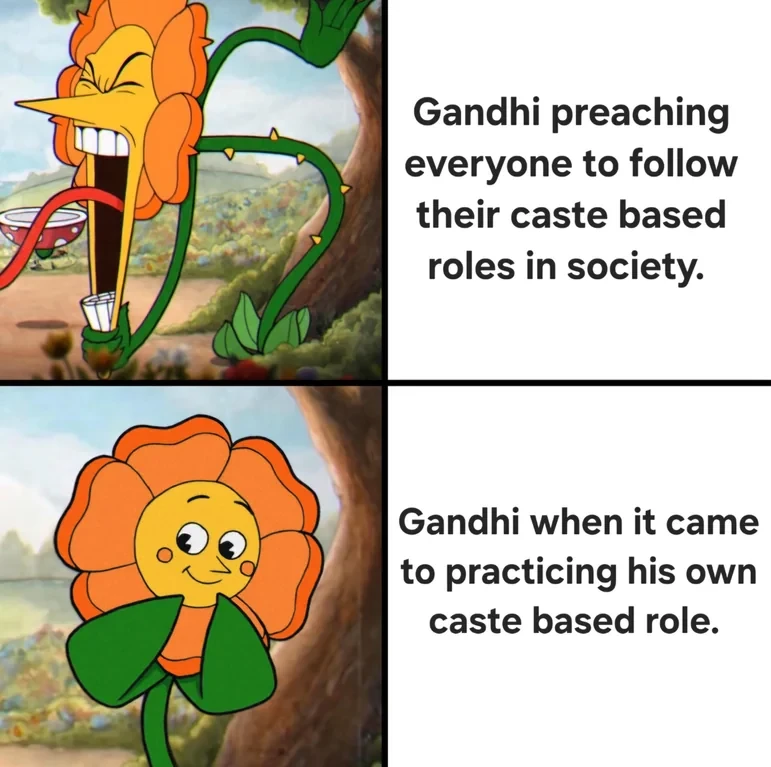
 Share on Mastodon
 Share on Reddit
 Share on WhatsApp
You don’t want to go down that rabbit hole. Many things about Ghandi are disturbing af.
It’s a good thing he didn’t get nukes
Context From Original OP:
Additional Context:
https://thewire.in/history/mahatma-gandhi-jayanti-ambedkar-caste
To Gandhi’s credit - acknowledging that there’s a lot he did that should be questioned - he completely changed his view on this by the 40s, in part due to his debates with Ambedkar.
His views on caste can be summarized in three phases
1915 to 1920s: Traditionalist - likely shaped in part by his upbringing in the British education system - where he saw caste as absolute and hierarchical. Not meaningfully different from the European/colonial worldview at the time, where white people were essentially “high caste” and black people were “low caste”.
1930s: Debates with Ambedkar where he tries to seperate caste from varna - ie. hold onto the idea of heriditary occupations and clans but remove the hierarchical aspect. Gets absolutely cooked by Ambedkar as u/PugJesus points out above.
1940s: Abolitionist - By 1945, he writes that the caste system has to be completely destroyed. He effectively abandons his defense of hereditary occupations, realizing it is impossible to separate from oppression.
Again, there’s a lot to question of Gandhi’s actions, but the world would be a better place if it was the norm to respond this way in the face of hipocrisy.
I wonder if that was the inspiration for the episode Ascension DS9 S04E17