Explanation: After the mercurial dictator of Libya, Muammar Gadaffi, had a bit of a disagreement with Egypt in the Egyptian-Libyan War (the Libyans did not, in fact, defeat the Egyptians there), he largely abandoned the pan-Arabist notions that Egypt was seen as championing at the time. Instead, Gadaffi decided, Libya would find its own way, without any outdated notions of Egyptian-led Pan-Arab unity! Obviously, using the old pan-Arab flag that he had previously dedicated Libya to was out of the question. So the new flag chosen was…
Green.
Just green.
This was in-line with the very Islamist leanings of Gadaffi’s government, as green is a color strongly associated with Islam, and Gadaffi’s government had reintroduced Sharia law to Libya, despite the general trend of the period being secular socialism, but it is, uh… a very… interesting choice of flag… design.
 RetroFed
 PugJesus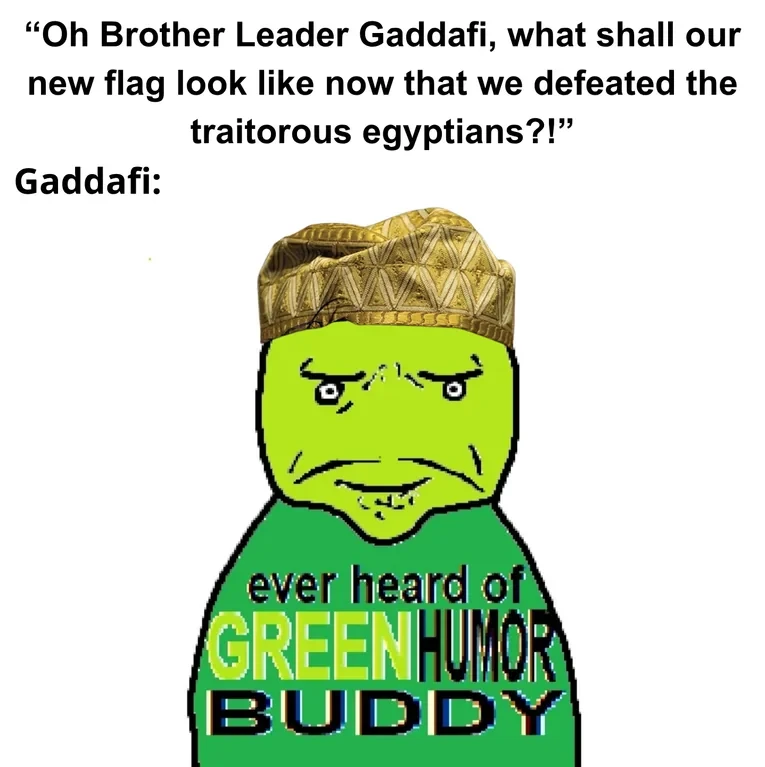
 Share on Mastodon
 Share on Reddit
 Share on WhatsApp
Explanation: After the mercurial dictator of Libya, Muammar Gadaffi, had a bit of a disagreement with Egypt in the Egyptian-Libyan War (the Libyans did not, in fact, defeat the Egyptians there), he largely abandoned the pan-Arabist notions that Egypt was seen as championing at the time. Instead, Gadaffi decided, Libya would find its own way, without any outdated notions of Egyptian-led Pan-Arab unity! Obviously, using the old pan-Arab flag that he had previously dedicated Libya to was out of the question. So the new flag chosen was…
Green.
Just green.
This was in-line with the very Islamist leanings of Gadaffi’s government, as green is a color strongly associated with Islam, and Gadaffi’s government had reintroduced Sharia law to Libya, despite the general trend of the period being secular socialism, but it is, uh… a very… interesting choice of flag… design.